Region Guide
Bore Water Filtration in WA: Treating Iron, Hardness & Salinity
Bore water across Western Australia comes with its own cocktail of iron, hardness and salt. Here's how to identify what you're dealing with and the filtration that actually fixes it.
Bore water is a cornerstone of life across regional and outer-metro Western Australia. It's used to top up pools, irrigate gardens, supply stock troughs and, on plenty of properties, run the whole house. The trade-off is that bore water rarely arrives at your tap in a state you'd actually want to drink, shower in or send through expensive appliances.
The good news is that the issues with bore water are well understood and very treatable. Here's how to identify what you're dealing with and what filtration actually fixes each problem.
What makes bore water different
Bore water comes out of an aquifer underground rather than a treated municipal supply. There's no chlorine, no fluoride and no utility standardising the chemistry before it reaches you. What you get instead is a snapshot of whatever's dissolved in the rock and soil where your bore is drilled.
In WA the most common issues fall into three categories: iron, hardness and salinity. Many properties have all three at varying levels.
Iron: the orange stain problem
Iron is the single most visible bore water complaint. You'll see it as orange or brown staining on paving, on fence palings, on white concrete and, eventually, on bathtubs and toilet cisterns if the water reaches the house unfiltered. It also gives the water a metallic taste and can leave clothes with rust-coloured marks.
Iron exists in bore water in two forms. Dissolved (ferrous) iron is invisible coming out of the tap, then oxidises to that classic rust colour as it meets air. Particulate (ferric) iron is already oxidised and looks orange straight from the bore.
The right treatment depends on the form and concentration. Light iron loads can be handled with a specialty iron-reduction cartridge in a whole-house housing. Heavier iron loads need a dedicated iron filter with media that oxidises and traps the iron before the main filtration stages.
Hardness: scale, soap scum and short appliance life
Hardness measures the calcium and magnesium dissolved in the water. WA bore water frequently runs hard to very hard, particularly in agricultural regions.
You'll know you have hard water if soap doesn't lather well, if your kettle scales up quickly, if shower screens cloud over and stay cloudy, and if hot water systems and dishwashers seem to fail earlier than they should. Hardness doesn't make water unsafe, but it costs you money in maintenance and replacement.
The fix is usually a water softener or a hardness-reduction stage paired with the main filtration. The right approach depends on whether you want to soften the whole house or just protect critical appliances.
Want a tailored bore water solution for your property?
Salinity: the dissolved-solids issue
Salinity is measured as Total Dissolved Solids (TDS). High-TDS bore water tastes salty or bitter, leaves white crusty deposits, kills sensitive plants when used on the garden, and shortens the life of any equipment it touches.
Carbon filtration doesn't touch dissolved salts. The only filtration technology that reliably reduces salinity is reverse osmosis. For drinking water that's straightforward — an under-sink RO unit produces excellent drinking water from even quite salty bore supplies. For whole-house desalination at scale, the equipment is larger and more involved, and we'd talk through whether it's the right approach for your property.
Testing first, building second
We don't recommend ordering a bore water system off a brochure. Every bore is different, and the cost difference between "adequate" and "overengineered" is significant. Before designing a system we'll either review a recent water-quality test or organise one for you.
A useful test measures at minimum:
- Iron (total and dissolved)
- Total hardness (calcium and magnesium)
- Total Dissolved Solids and salinity
- pH
- Manganese (often present alongside iron)
- Bacteria, if the bore feeds drinking water
With those numbers in front of us we can size every stage correctly and avoid the most common mistakes — undersized iron media, missing softener, RO unit fed water it can't cope with.
A typical WA bore water system
For a rural or semi-rural property running mostly on bore, a typical setup looks like:
- A dedicated iron and manganese stage at the front, sized for the bore's flow rate
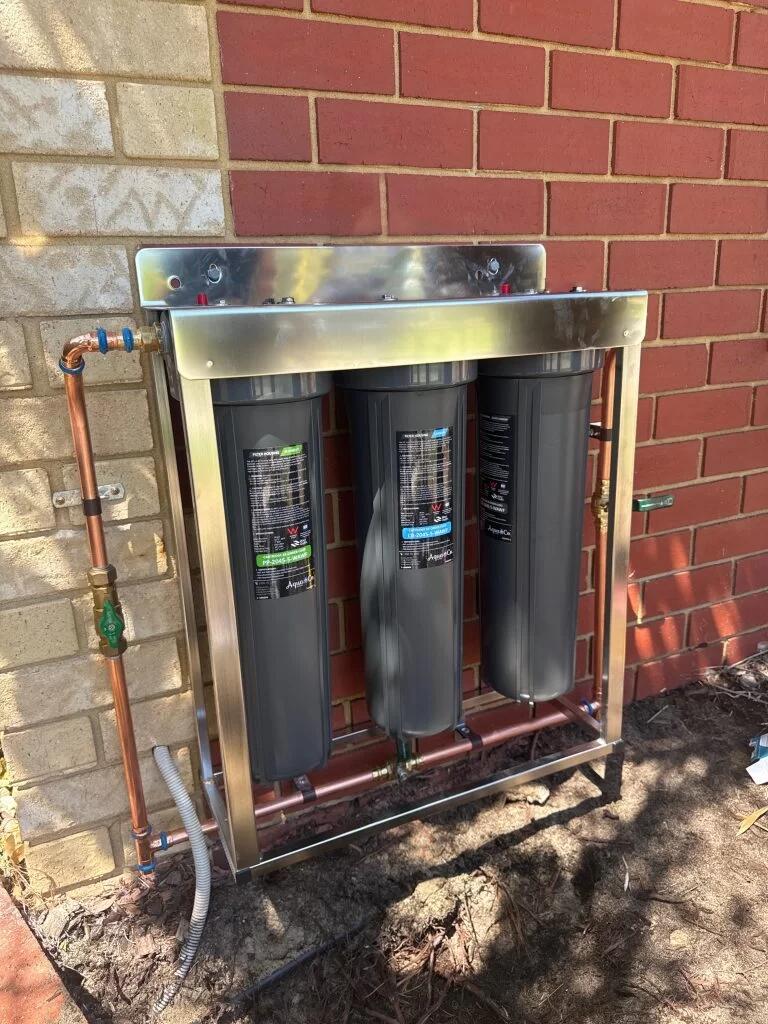
- A whole-house sediment and carbon filtration train
- A hardness reduction or softening stage if appliance protection is a priority
- An under-sink reverse osmosis unit at the kitchen tap for drinking water
That combination handles the vast majority of WA bore water situations. We tailor each stage to the actual test results so you're not paying for capacity you don't need.
Servicing Australia-Wide
We design and install systems for households right across the country. Local water varies, so every system is matched to your area.
- Perth WA
- Mandurah
- Bunbury
- Kalgoorlie
- Adelaide SA
- Melbourne VIC
- Sydney NSW
- Brisbane QLD
- Darwin NT
- Hobart TAS
What it costs and how to start
A bore water system costs more to design and install than a straightforward mains setup because there's more equipment involved and the design needs to be matched to your test results. Our Interest Free Payment Plan through Humm starts at $0 upfront with terms from 6 to 36 months, so the investment doesn't need to land in one go.
The starting point is a conversation. Tell us about your bore, any test results you have, and what you're noticing on the property. We service bore water customers right across WA and beyond and we'll give you a straight answer on what your property needs.
Next Step
Ready to Feel the Difference in Your Water?
Better water for your family is just one quick conversation away…